

Solo founders spend 80% of their time on tasks a $50K employee could handle. You know the routine: answering customer emails at midnight, manually posting social media content, copying data between spreadsheets, and scheduling meetings through endless email chains. These operational tasks consume your days while actual business building gets pushed to weekends. By automating business processes, solo founders can shift their focus from repetitive tasks to growth and innovation.
The brutal math of solo founding means you can’t afford to hire yet, but you’re drowning in work that doesn’t move the needle. Every hour spent on administrative tasks is an hour not spent on product development, strategy, or revenue generation. Most solo founders hit a revenue ceiling around $200K because they become the bottleneck in their own business.
This operational overwhelm kills more startups than bad products or weak markets. When founders spend their time like assistants, they can’t think like CEOs. The constant context switching between marketing, sales, operations, and customer service fragments focus and prevents deep work on what actually matters.
The right automation stack changes this completely. Instead of hiring multiple employees you can’t afford, artificial intelligence tools handle routine work while you focus on high-impact activities. Such automation technologies increase productivity and reduce costs for solo founders. A well-designed automation system replaces the work of a marketing coordinator, sales assistant, operations manager, and customer service rep for under $500 per month.
The difference between successful solo founders and those who burn out isn’t work ethic or intelligence. It’s systems thinking. Winners build automations that handle predictable work, freeing them to do what only founders can do: make strategic decisions, build relationships, and drive innovation. Efficient automation devices and technologies streamline operations, making business processes smoother and more effective. The goal isn’t to work less, it’s to work on what matters most.

Why Solo Founders Need Automation Stacks
The Solo Founder Time Trap
Managing 15+ different business functions alone creates an impossible juggling act that destroys productivity and stunts growth. Solo founders wear every hat: CEO, marketer, salesperson, customer service rep, accountant, HR manager, and product developer. Each role requires different skills, tools, and mindsets, making effective execution nearly impossible.
Context switching kills deep work and innovation because your brain needs time to fully engage with complex problems. When you jump from writing marketing copy to debugging code to answering customer support tickets, you never reach the focused state required for breakthrough thinking. Research shows it takes 23 minutes to fully refocus after an interruption, but most solo founders switch contexts every 10-15 minutes.
This constant task switching creates the illusion of productivity while preventing actual progress. You feel busy all day but struggle to point to meaningful accomplishments. Important strategic work gets postponed indefinitely because urgent operational tasks always demand immediate attention.
Revenue caps at founder’s personal capacity because there are only 24 hours in a day and only so many tasks one person can handle effectively. When the founder is the entire business operation, growth requires working more hours rather than building better systems. This approach leads to burnout, not scalable businesses.
The time trap becomes a growth trap when potential customers can’t get quick responses, marketing campaigns run sporadically, and product development slows to accommodate operational demands. Your business growth becomes limited by your personal bandwidth rather than market opportunity.
How Artificial Intelligence Tools Change This
AI handles repetitive tasks 24/7 without sick days, vacation time, or performance management. While you sleep, artificial intelligence tools can respond to customer inquiries, qualify leads, update databases, and prepare reports. This around-the-clock availability means your business operates continuously without requiring your constant attention.
Unlike human employees, AI tools don’t need training periods, salary negotiations, or team management. They start working immediately and improve performance over time through machine learning. Automations run consistently without mood fluctuations, distractions, or human error that can derail important processes. Feedback mechanisms in automation systems monitor outputs and compare them to desired setpoints, allowing the system to make real-time adjustments that maintain accuracy and enhance performance.
Automations create consistent processes without management by following predetermined rules and workflows exactly as designed. Every customer receives the same quality experience, every lead gets the same follow-up sequence, and every task gets completed according to your specifications. This consistency builds trust and reliability that’s difficult to achieve with manual processes.
The compounding effect of automation means each task you automate frees up time that can be reinvested in automation additional processes. Over time, your artificial intelligence tools handle an increasing percentage of operational work while you focus on strategic activities that only humans can perform effectively.
Quality often exceeds human performance for routine work because AI doesn’t get tired, distracted, or forget important steps. Automated email sequences send at optimal times with perfect personalization. Social media posts publish on schedule with consistent branding. Data analysis happens without calculation errors or missed insights.
This superior performance in routine tasks means automation is about improving business outcomes. Customers receive faster, more accurate service. Marketing campaigns run more consistently. Operations become more reliable and predictable, creating the foundation for sustainable growth.
The 5-Layer Automation Stack Framework
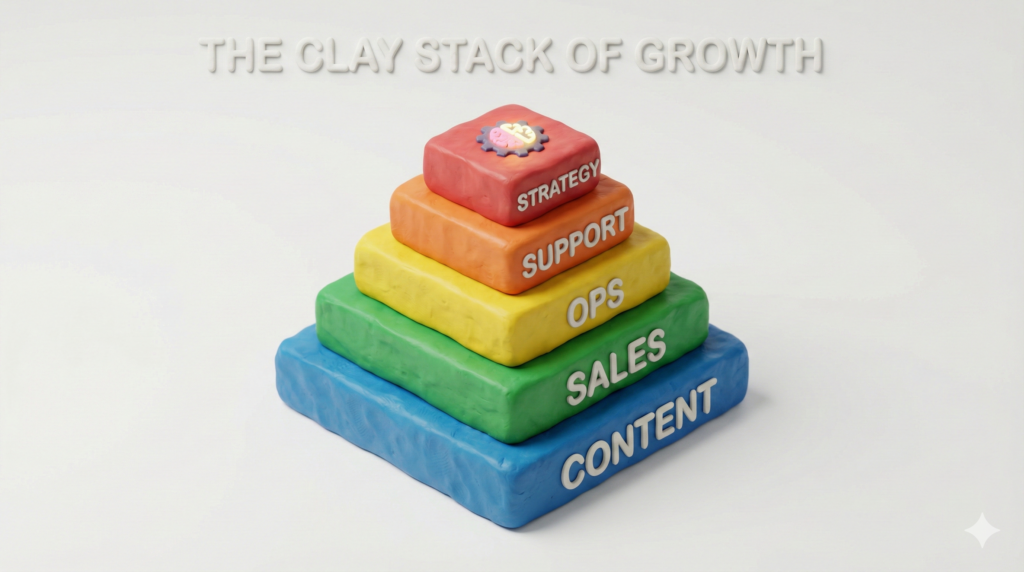
Building an effective automation system requires strategic layering that starts with foundational tasks and advances to complex decision-making. Each layer builds on the previous one, creating a comprehensive system that handles everything from content creation to strategic analysis. This framework ensures you automate the right tasks in the right order for maximum impact.
Layer 1: Content Creation & Marketing Automation
Content marketing consumes 20-30 hours per week for most solo founders, making it the perfect starting point for automation. This layer handles content production, distribution, and optimization that traditionally requires a dedicated marketing team.
AI-Writer transforms blog creation from a weekly struggle into a systematic process. Instead of spending entire days crafting blog posts, use AI-Writer to generate first drafts based on your topic and target keywords. The tool analyzes top-ranking content and creates comprehensive outlines that include SEO optimization and readability improvements. AI-Writer can also analyze content from relevant websites to further enhance blog quality and ensure your posts are competitive in your niche.
Set up AI-Writer with your brand voice guidelines, target audience details, and content goals. The system learns your writing style over time, producing drafts that require minimal editing. For solo founders, this means going from 8 hours per blog post to 2 hours of editing and optimization. The time savings compound weekly, freeing up 20+ hours monthly for strategic work.
Configure AI-Writer workflows that connect to your content calendar. When you add a topic to your editorial schedule, the system automatically generates outlines, researches competitors, and drafts initial content. This automation ensures consistent content production even during busy periods when manual writing would get postponed.
Creator Studio eliminates the daily social media management burden through intelligent scheduling and cross-platform publishing. Solo founders often struggle with social media consistency because posting requires daily attention that competes with other priorities. Creator Studio solves this by automating the entire posting process across multiple platforms.
Upload your content once and Creator Studio automatically adapts it for LinkedIn, Twitter, Instagram, and Facebook. The system optimizes posting times based on your audience engagement patterns, ensuring maximum reach without manual timing decisions. For video content, the platform generates multiple formats suitable for different platform requirements.
Set up content series and campaigns that run automatically for weeks. For example, create a “Founder Tips” series that posts weekly insights across all platforms with platform-specific formatting and hashtags. Creator Studio also offers pre-built templates for content automation and campaign management, making it easy to launch and manage campaigns efficiently. This automation creates consistent brand presence while you focus on business development rather than content distribution.
Artificial intelligence SEO tools** optimize content for search visibility without requiring SEO expertise.** Tools like Surfer SEO and Clearscope analyze top-ranking content and provide specific recommendations for keyword usage, content structure, and optimization opportunities.
Integrate SEO automation into your content workflow so every piece gets optimized before publication. The system analyzes your draft content, suggests keyword improvements, and provides readability scores that ensure your content ranks well and engages readers effectively. This automation replaces the need for dedicated SEO specialists while improving content performance.
Layer 2: Sales & Outreach Automation
Sales activities consume massive amounts of time for solo founders while producing inconsistent results. This layer automates prospecting, follow-up sequences, and lead management that typically requires dedicated sales staff.
Phantombuster automates LinkedIn prospecting at scale by identifying ideal prospects, sending connection requests, and managing follow-up sequences. Instead of spending hours manually searching for prospects and sending individual messages, Phantombuster handles the entire prospecting workflow automatically.
Configure Phantombuster to identify prospects based on specific criteria: job titles, company sizes, industries, or geographic locations. The system sends personalized connection requests and follow-up messages based on your templates, tracking response rates and engagement levels for optimization.
Set up multi-step sequences that nurture prospects over weeks or months. When someone accepts your connection request, Phantombuster automatically sends a welcome message, shares relevant content, and schedules follow-up touchpoints. This automation ensures no prospects fall through the cracks while maintaining consistent outreach volume.
Email sequences and CRM automation manage the entire sales pipeline from initial contact to closed deals. Tools like HubSpot or Pipedrive automate lead scoring, follow-up emails, and deal progression tracking that prevents manual sales management mistakes.
Create automated email sequences triggered by specific prospect actions: downloading resources, visiting pricing pages, or attending webinars. These sequences provide relevant information at the right time, moving prospects through your sales funnel without manual intervention. Each sequence includes multiple touchpoints spread over weeks, ensuring consistent follow-up that most solo founders struggle to maintain manually.
Lead qualification and scoring systems identify your best prospects automatically using behavioral data and engagement metrics. Instead of treating all leads equally, automation scores prospects based on actions that indicate purchase intent: email opens, content downloads, website visits, and social media engagement.
Configure lead scoring that assigns points for different actions, automatically identifying hot prospects for immediate attention. When prospects reach specific scores, the system triggers alerts and advanced nurture sequences. This automation ensures you focus sales efforts on qualified leads while keeping lower-priority prospects engaged through automated sequences.
Layer 3: Operations & Project Management
Operational tasks often consume 40% of a solo founder’s time through project management, documentation, and administrative work. This layer creates systematic workflows that handle business operations without constant founder oversight.
Monday.com automations streamline workflow management through automated task creation, deadline tracking, and status updates. Instead of manually managing projects and deadlines, Monday.com creates automated workflows that handle routine project management tasks.
Set up project templates that automatically create task sequences for recurring processes: product launches, content creation, or client onboarding. When you start a new project, the system generates all necessary tasks with appropriate deadlines, assigned responsibilities, and progress tracking. This automation ensures nothing gets overlooked while reducing project management overhead.
Configure automated notifications and escalations that alert you when projects require attention. The system monitors deadlines, budget utilization, and task dependencies, sending alerts before problems become critical. This proactive management prevents issues while reducing the mental overhead of tracking multiple projects simultaneously.
Document generation and contract automation eliminates repetitive administrative work through tools like PandaDoc or DocuSign. Create templates for contracts, proposals, and other business documents that populate automatically with client information and project details.
Set up workflows that generate contracts when deals reach specific pipeline stages. The system pulls information from your CRM, creates properly formatted documents, and sends them for electronic signatures automatically. This automation reduces document preparation time while ensuring consistency and professional presentation.
Financial tracking and reporting systems provide real-time business insights without manual bookkeeping. Tools like QuickBooks or Xero automatically categorize expenses, track revenue, and generate financial reports that inform business decisions.
Connect bank accounts and payment systems for automatic transaction recording and categorization. The system recognizes recurring expenses, properly categorizes income sources, and generates monthly financial reports without manual data entry. This automation provides accurate financial visibility while eliminating time-consuming bookkeeping tasks.
Layer 4: Customer Service & Communication
Customer communication often becomes a 24/7 responsibility for solo founders, creating stress and limiting personal time. This layer automates routine communication while maintaining service quality.
Lindy revolutionizes meeting scheduling and email management by acting as your AI assistant for routine communication tasks. Instead of endless email chains to schedule meetings, Lindy handles calendar coordination, sends meeting reminders, and manages follow-up communications automatically.
Configure Lindy to access your calendar and email, enabling it to schedule meetings based on your availability and preferences. The system sends professional meeting invitations, coordinates with multiple participants, and handles rescheduling requests without your involvement. This automation eliminates scheduling friction while maintaining professional communication standards.
Set up email templates and responses that Lindy uses for common inquiries. The system identifies email types and sends appropriate responses, escalating complex issues to your attention. This automation handles routine correspondence while ensuring important communications receive prompt attention.
Superhuman transforms email productivity through AI-powered features that accelerate email processing and reduce inbox management time. The platform uses artificial intelligence to prioritize important emails, suggest responses, and automate routine email tasks.
Enable Superhuman’s AI features that automatically sort emails by importance, highlight urgent messages, and suggest quick responses for routine inquiries. The system learns your communication patterns and preferences, improving accuracy over time. This automation reduces email processing time while ensuring important communications receive appropriate attention.
Chatbots handle customer support automation for routine inquiries and frequently asked questions. Tools like Intercom or Zendesk Chat provide immediate responses to customer questions while collecting information for complex issues that require human attention.
Configure chatbots with knowledge bases that answer common questions about your products, services, pricing, and policies. The system provides instant responses 24/7 while escalating complex issues to your attention with relevant context. Automation systems are designed to handle routine inquiries efficiently, while reserving complex human tasks and decisions for your personal attention. This ensures that while automation streamlines repetitive processes, human oversight is maintained for unstructured or nuanced issues that require judgment. This automation improves customer satisfaction through immediate responses while reducing support workload.
Layer 5: Agentic AI for Strategic Tasks
The most advanced automation layer uses agentic AI for complex tasks that traditionally require strategic thinking and analysis. These tools don’t just follow rules, they make decisions and provide insights that inform business strategy.
Market research and competitive analysis become continuous processes rather than occasional projects. Agentic AI tools monitor competitor activities, market trends, and industry developments, providing regular insights that inform strategic decisions.
Configure AI systems to track competitor pricing, product launches, marketing campaigns, and hiring patterns. The system analyzes this data for trends and opportunities, providing weekly reports that highlight important market developments. This automation ensures you stay informed about competitive landscape changes without dedicating time to manual research.
Data analysis and reporting transform business data into actionable insights through automated analysis and visualization. AI tools process sales data, customer behavior, financial metrics, and operational performance, identifying patterns and opportunities that might be missed in manual analysis.
Set up automated reporting that analyzes key business metrics and identifies trends, anomalies, and improvement opportunities. The system generates monthly business reviews that highlight performance against goals, emerging opportunities, and areas requiring attention. This automation provides strategic visibility while eliminating time-consuming data analysis tasks.
Strategic planning assistance uses AI to evaluate business decisions, scenario planning, and strategic opportunities. Advanced AI tools analyze market conditions, competitive positioning, and business performance to provide strategic recommendations and risk assessments.
Configure AI advisors that evaluate new opportunities against your business goals and market conditions. The system provides analysis of potential partnerships, product extensions, market expansions, and strategic pivots, helping inform decision-making with data-driven insights. This automation augments strategic thinking rather than replacing it, providing analytical support that improves decision quality. Establish guidelines for when to rely on AI insights versus human judgment for strategic decisions.
Currently, the ability of automation systems is limited in areas such as pattern recognition, language comprehension, and subjective assessment, making human skills essential for complex decision-making where nuanced understanding is required.

Implementation Roadmap: 60-Day Automation Setup
Building an effective automation stack requires systematic implementation that prevents overwhelm while ensuring each layer works properly before adding complexity. This 60-day roadmap prioritizes high-impact automations while building foundational systems that support advanced AI integration.
Weeks 1-2: Foundation Layer (Core Tools)
Week 1 focuses on setting up your automation infrastructure and core productivity tools. Start with Superhuman for email management and establish your central workspace in Monday.com for project tracking. These foundational tools create the backbone for all future automations.
Configure Superhuman with your email accounts, set up keyboard shortcuts, and enable AI-powered features for email sorting and quick responses. This immediately improves email productivity while establishing patterns that support future communication automation.
Set up Monday.com with basic project templates for your most common workflows: content creation, client onboarding, and product development. Create automated status updates and notification rules that reduce manual project management overhead. This foundation supports all operational automations you’ll add later.
Week 2 adds Lindy for scheduling and basic communication automation. Connect Lindy to your calendar and email systems, enabling it to handle meeting coordination and routine correspondence. Configure email templates for common inquiries and establish escalation rules for complex issues.
Test all foundation tools with real workflows to identify integration issues before adding more complex automation layers. Document your initial processes and automation rules for future optimization and team onboarding.
Weeks 3-4: Content & Marketing Automation
Week 3 implements content creation automation with AI-Writer and establishes your content production workflow. Set up AI-Writer with your brand voice guidelines, target audience profiles, and content calendar integration. Configure the system to generate blog post outlines and first drafts based on your editorial calendar.
Create content templates and style guides that ensure consistent AI-generated content quality. Test the AI-Writer workflow with several blog posts, refining prompts and editing processes to achieve your quality standards efficiently.
Week 4 adds Creator Studio for social media automation and cross-platform content distribution. Connect all your social media accounts and configure posting schedules based on your audience engagement patterns. Set up content repurposing workflows that automatically adapt blog posts for different social platforms.
Implement artificial intelligence SEO tools like Surfer SEO or Clearscope into your content workflow. Configure automatic content optimization that analyzes drafts and provides specific improvement recommendations before publication. This integration ensures every piece of content gets properly optimized without manual SEO work.
Weeks 5-6: Sales & Operations Integration
Week 5 focuses on sales automation with Phantombuster for LinkedIn prospecting and CRM integration for lead management. Configure Phantombuster with your ideal customer profiles and personalized outreach sequences. Set up lead scoring and automated follow-up workflows in your CRM system.
Test prospecting automations with small audiences to refine messaging and targeting before scaling to larger prospect lists. Monitor response rates and engagement metrics to optimize your automated outreach performance.
Week 6 adds operational automations for financial tracking, document generation, and workflow management. Connect banking and payment systems to accounting software for automatic transaction categorization and financial reporting. Implement contract automation for recurring business documents and client agreements.
Configure advanced Monday.com automations that handle complex project workflows, resource allocation, and deadline management. These operational systems reduce administrative overhead while providing better business visibility.
Weeks 7-8: Advanced AI and Optimization
Week 7 implements agentic AI for market research, competitive analysis, and strategic insights. Configure AI systems to monitor competitor activities, industry trends, and market opportunities. Set up automated reporting that provides weekly strategic briefings and opportunity alerts.
Test advanced AI capabilities with real business scenarios to understand their strengths and limitations. The power of advanced automation systems can transform business operations by delivering faster insights and more effective decision-making. Establish guidelines for when to rely on AI insights versus human judgment for strategic decisions.
Week 8 focuses on optimization, integration testing, and performance measurement. Analyze the effectiveness of each automation layer and identify areas for improvement. Configure comprehensive reporting that tracks automation performance, time savings, and business impact.
Document your complete automation stack with usage guidelines, troubleshooting procedures, and optimization recommendations. Create backup plans for critical automations to ensure business continuity if systems fail.
Common Automation Mistakes That Waste Money
The Shiny Tool Syndrome
The biggest automation mistake is purchasing every new tool that promises to solve business problems without evaluating whether it fits your actual workflow needs. The easy availability of free automation tools can also lead to tool overload, as the temptation to try out no-cost options often results in adopting unnecessary or redundant solutions. Solo founders often accumulate dozens of automation tools that overlap functionality, create integration problems, and increase monthly expenses without delivering proportional value.
Each new tool requires setup time, learning curve investment, and ongoing management attention. When you have too many tools, you spend more time managing automation than the automation saves. The result is increased complexity and costs without meaningful productivity improvements.
Successful automation requires strategic tool selection based on specific workflow needs rather than feature lists or marketing promises. Before adding any tool, identify the exact process you want to automate and measure the time currently required. Only invest in automations that save more time than they require to maintain.
Over-Automation Without Process
Automating broken or inefficient processes just creates faster mistakes and compounds existing problems. Many founders rush to automate before documenting their current workflows, missing opportunities to improve processes before automation implementation.
Automation works best when applied to well-defined, repeatable processes that produce consistent outcomes. If your current process has exceptions, unclear steps, or variable results, automation will amplify these problems rather than solving them. The result is unreliable automation that requires constant manual intervention.
Successful automation requires process documentation and optimization before implementation. Document each step of your current workflow, identify improvement opportunities, and standardize procedures before building automations. This foundation work ensures your automations enhance good processes rather than accelerating bad ones.
Ignoring Human Touch Points
The most expensive automation mistake is removing human interaction from processes that require personal connection for effective results. Not every task should be automated, and some customer touchpoints become more valuable when they remain personal and authentic.
Over-automation can damage customer relationships when routine interactions become impersonal or when complex issues get stuck in automated systems without human escalation options. Customers often value the personal attention that solo founders can provide, and removing this advantage through excessive automation can hurt differentiation.
Strategic automation preserves human touchpoints for high-value activities while automating routine tasks that don’t require personal attention. Focus automation on administrative work, data processing, and routine communications while maintaining human involvement in relationship building, strategic decisions, and complex problem-solving.
ROI Calculator: What Automation Actually Saves
Time savings per tool category provide measurable benefits that justify automation investments through quantifiable productivity improvements. Content automation typically saves 15-20 hours weekly through AI-generated drafts, automated publishing, and SEO optimization. Sales automation saves 10-15 hours weekly through prospecting, lead qualification, and follow-up sequences.
Operations automation saves 8-12 hours weekly through project management, financial tracking, and document generation. Customer service automation saves 5-10 hours weekly through automated responses, scheduling, and routine inquiry handling. These time savings compound monthly, freeing up 150+ hours for strategic work that drives revenue growth.
Cost comparison vs. hiring employees shows automation delivers equivalent functionality at a fraction of employment costs. A marketing coordinator costs $50,000+ annually plus benefits, while content automation tools cost $3,000-5,000 yearly. Sales assistants cost $40,000+ annually, while sales automation costs $2,000-4,000 yearly.
Operations managers cost $60,000+ annually, while operational automation costs $3,000-6,000 yearly. Customer service representatives cost $35,000+ annually, while customer service automation costs $1,000-3,000 yearly. Total automation stack costs typically range from $400-600 monthly, replacing $200,000+ in annual salary costs.
Revenue impact of automated systems extends beyond cost savings through improved consistency, scalability, and strategic focus. Automated lead generation and follow-up systems typically increase conversion rates by 20-30% through consistent touchpoints and timely responses. Content automation improves SEO performance and thought leadership visibility, driving organic lead generation.
Operational automation reduces errors and improves delivery consistency, increasing customer satisfaction and referral rates. The time savings from automation enables founders to focus on strategic activities like product development, partnership building, and market expansion that directly drive revenue growth. Most solo founders see 40-60% revenue increases within six months of implementing comprehensive automation systems.
Conclusion: From Solopreneur to AI-Powered Business (200 words)
The 5-layer automation framework transforms solo founders from overwhelmed operators into strategic leaders. Layer 1 handles content creation and marketing through AI-Writer, Creator Studio, and artificial intelligence SEO tools. Layer 2 automates sales with Phantombuster prospecting and CRM sequences. Layer 3 manages operations through Monday.com automations and financial systems. Layer 4 streamlines communication via Lindy scheduling and Superhuman productivity. Layer 5 adds agentic AI for strategic analysis and market research.
This systematic approach replaces the work of multiple employees for under $500 monthly while improving consistency and quality. Instead of spending 80% of your time on operational tasks, automation handles routine work while you focus on activities that only founders can perform: strategic decisions, relationship building, and innovation.
Automation enables scaling beyond personal limits because systems work 24/7 without management overhead, sick days, or performance issues. Your business operates continuously, responds to customers instantly, and maintains consistent marketing presence regardless of your personal bandwidth. Revenue growth becomes limited by market opportunity rather than founder capacity.
The difference between struggling solopreneurs and successful AI-powered businesses isn’t work ethic or intelligence, it’s systems thinking. Winners build automations that compound over time, creating sustainable competitive advantages through operational excellence.
Ready to build your automation stack? Tellr’s AI Systems consultation helps founders implement proven automation frameworks that replace teams while preserving what makes you unique. Transform your business from personal dependency to systematic growth.
Decision Making and Automation
Decision making sits at the heart of business automation, transforming how organizations operate and compete in today’s fast-paced markets. For solo founders, leveraging automation tools and AI agents means you’re no longer bogged down by repetitive tasks or manual work like data entry—instead, you can focus on more meaningful work that drives your business forward.
Modern automation tools, powered by advanced machine learning models and AI capabilities, can analyze massive amounts of data in real time. These systems don’t just automate routine processes—they provide actionable insights and even make decisions independently, reducing the need for constant human intervention. For example, agentic AI tools can monitor workflows, identify bottlenecks, and optimize operations without waiting for a human to step in. This level of business automation allows you to act quickly and efficiently, even in complex environments where every second counts.
The automation department in larger organizations is responsible for implementing and maintaining these systems, ensuring that everything runs smoothly and efficiently. In the automotive industry, companies like General Motors have embraced extensive automation on their production lines. Here, machines and computers perform tasks that once required teams of human workers, dramatically increasing productivity and reducing costs. These real-world applications of automation demonstrate how AI agents and computer science innovations are reshaping industries—machines now act independently, adapt to new situations, and make decisions in real time.
Agentic AI tools aren’t limited to manufacturing. In home automation, for instance, smart systems learn your preferences and adjust lighting, temperature, and security settings automatically. In finance and healthcare, AI agents process data, flag anomalies, and recommend actions, freeing up employees to focus on strategy and customer relationships. Generative AI and natural language processing can automate manual tasks like data entry, customer support, and content creation, allowing your team—or just you, as a solo founder—to focus on high-value business decisions.
By automating decision making and routine processes, businesses not only increase efficiency but also empower employees to perform tasks that require creativity, judgment, and strategic thinking. The result is a shift from manual, repetitive work to more meaningful work that drives growth and innovation. Whether you’re running a lean startup or managing a growing enterprise, integrating automation tools and AI agents into your operations is essential for staying competitive, reducing costs, and scaling your impact in today’s complex business landscape.